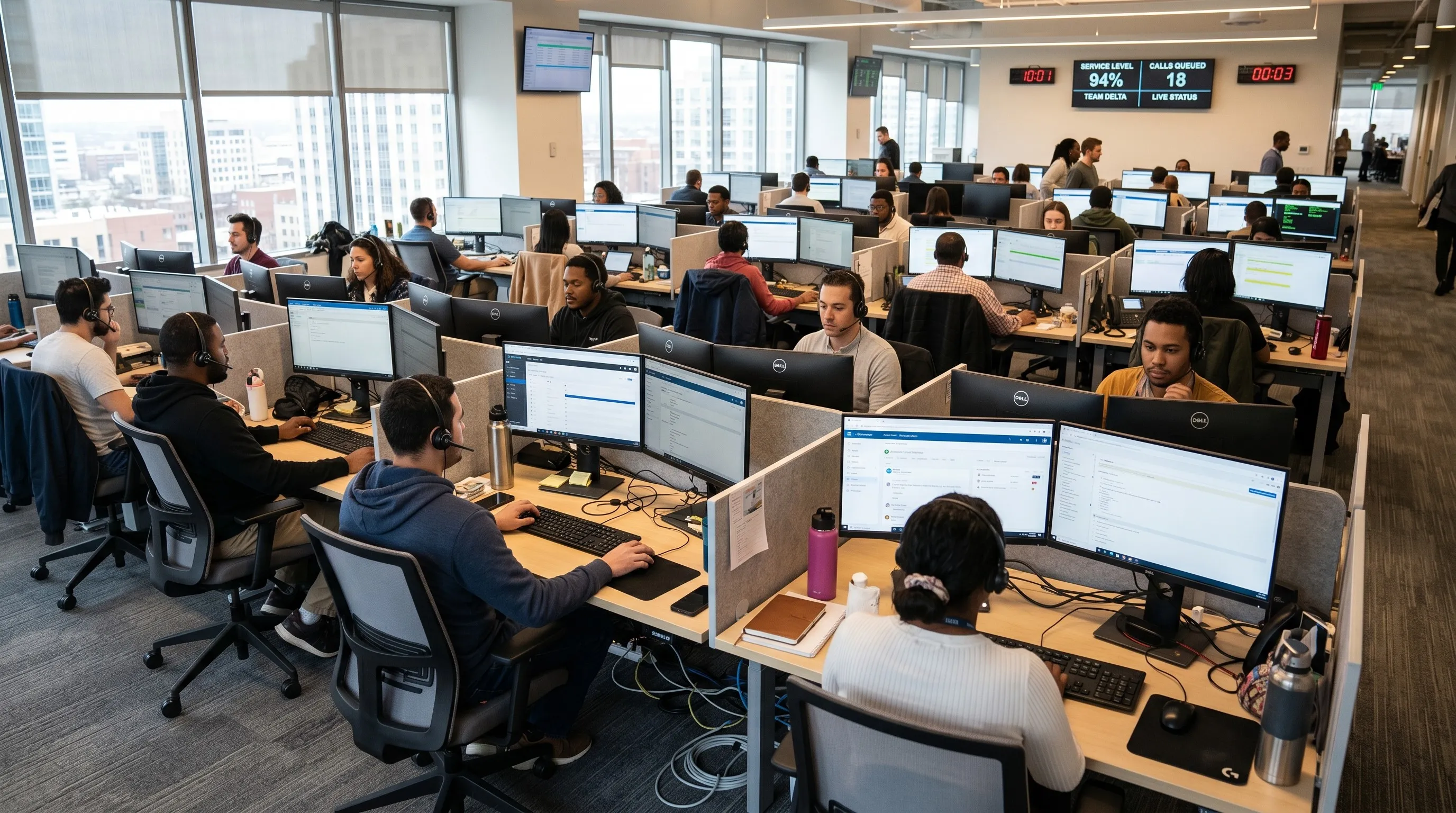
A product launch is two weeks out. Your support queue is already running an hour behind on weekday afternoons, and the launch will add chat volume, voice volume, and a backlog of returns inside a 30-day window. Hiring and training a new class of agents takes six weeks. The launch does not.
This is the situation that pushes most operations leaders to look at customer service outsourcing for the first time. Not a strategic restructuring of the support org. A specific volume problem with a specific deadline, where the in-house option is not arithmetically possible.
We have been running outsourced support since 1998, and the calls we get fall into recognizable patterns: a 24/7 requirement the headcount math will not justify, a launch or recall window hiring cycles cannot meet, or a compliance scope the team wants off their own environment. This post walks through what customer service outsourcing actually is, when it works, what to evaluate in a provider, and what good looks like in production.
What customer service outsourcing is
Customer service outsourcing is the arrangement where an external provider runs your customer support operation under your brand. The agents are employed by the provider. The phone numbers, the policies, the tone, the SLAs, and the customer relationship are still yours. The provider supplies the people, the workforce management, the training infrastructure, the QA function, and the technology stack that the operation runs on.
The term covers a wide surface area. We focus this post on voice work, both inbound (the customer service line that handles questions, complaints, and account issues) and outbound (retention calls, win-back campaigns, appointment confirmation). Voice is where most of the cost sits and where the operational stakes are highest, so it is the natural starting point for a buyer evaluating outsourcing.
But the same provider relationship typically extends to the other channels a modern support operation runs. Live chat handles the synchronous text traffic from your site and product. Email and ticket support handles the asynchronous queue. Back-office work covers the document processing, claims handling, and data entry that often sits behind the customer-facing channels. And IVR and IVA automation takes the simple, repetitive transactions off the agent queue entirely. Most programs we run touch at least three of these.
Why B2B companies outsource customer service
Three reasons account for most of the outsourcing conversations we have with B2B buyers.
24/7 coverage at a defensible cost
If your product is used outside business hours, or your customers are distributed across time zones, the question of after-hours coverage shows up fast. The math is unforgiving. Running a single seat 24/7, every day of the year, takes roughly 4 to 5 full-time agents once you account for three shifts, weekend rotation, PTO, sick time, and training hours. A team that comfortably covers business hours with 10 agents needs 40 to 50 to cover the clock at the same service level.
A shared-agent BPO pools agents across multiple programs, so idle time on any one program gets absorbed into productive time on another. The cost-per-covered-hour comes down meaningfully, and the 2am shift stops being a recruiting problem you solve every quarter.
Volume elasticity without hiring cycles
A product launch, a seasonal surge, a recall campaign with a regulator-defined window, or a billing-system migration that drives a one-time spike in calls. None of those wait six weeks for a new hiring class to clear training. A BPO can ramp in days because the bench, the trainers, the workstations, and the curriculum-development capacity are already in place. The same applies in reverse when the surge is over and the headcount needs to come back down without a layoff event on your books.
Compliance scope offload
If your support operation handles cardholder data, the entire environment that touches it falls inside your PCI-DSS audit scope. That means the agent desktops, the call recording system, the network segments those calls traverse, and the people who administer all of it. Shifting the cardholder-data handling to a PCI-certified BPO lets you contractually transfer that scope and shrink your own assessment. The PCI Security Standards Council publishes the framework that defines what falls in and out of scope, and the savings on assessor fees and internal engineering hours often cover a meaningful portion of the program cost on their own. The same logic applies to HIPAA. We get into how we run the operational side of that later in the post.
When outsourcing makes sense — and when it doesn’t
Signals the in-house operation has hit its limit
The first is a 24/7 demand the team cannot sustain without burnout. Overnight and weekend shifts stood up as a stretch are now quarterly attrition events, and recruiters cannot refill seats fast enough.
The second is recurring overtime that has stopped being recurring and started being structural. If the schedule only works when half the team picks up extra shifts every week, the headcount plan is wrong.
The third is a regulated data environment the operation was never built for. PCI-DSS, HIPAA, and TCPA each drag audit scope, network segmentation, and access controls onto a team set up to answer questions. When compliance starts dictating the roadmap, the operation is outside its design envelope.
The fourth is contact volume that spikes faster than hiring cycles can absorb. Six weeks of training against a three-week launch window does not work, and running it twice does not change that.
The fifth is customer languages the in-house team cannot staff. Bilingual Spanish, French, or Portuguese coverage is a recruiting problem in most US metros, worse still when the requirement is bilingual plus licensed or PCI-trained.
When outsourcing is the wrong call
Highly technical tier-3 support that sits next to engineering does not outsource well. If the agent needs to read a stack trace, reproduce a bug, or file a ticket a developer will act on that sprint, the embed cost is higher than the labor savings.
Very early-stage products where the operation is still changing week to week are another poor fit. A BPO optimizes for stable processes and measurable SLAs. If the runbook is being rewritten every Friday, there is nothing stable to hand off.
And in the rare B2B case where brand voice is the product itself, keep it in-house. It is uncommon outside D2C lifestyle and luxury categories, but no calibration will reproduce a voice the founders still personally coach.
What to evaluate in a provider
Once the decision is made to evaluate providers, the question shifts to “who actually runs a good operation.” Seven things to press on in the first two meetings.
Ask about training, not whether they train. Is there a written curriculum for your specific program, or is it a handoff binder and a week of shadowing? How long is initial training, how long is nesting, and what does the assessment at the end of each look like? Weak providers train to a generic baseline and count on tenure to close the gap. Strong ones build program-specific curriculum and will show you the materials before you sign.
Ask about QA methodology. How are calls scored, who writes the scorecard, and how often are agents coached on results? Does the client see scores, or just a monthly summary? A provider who treats QA as internal-only is one you will be writing escalation emails to six months in. Scores go to clients as each scorecard is completed; that is the baseline we think any serious partner should meet.
Ask about compliance posture. Not “are you compliant,” but where does the data sit, who has access, how is access logged, when was the last third-party audit, and what was in the finding letter. If the answer is vague, the posture is vague.
Ask about reporting cadence. Is there daily SLA visibility with a dashboard you can log into, or are you waiting for a Monday-morning deck? When something breaks, does the provider call you before you notice, or do you find out when a customer tweets? Cadence is a proxy for how the operation is run.
Ask about workforce stability. What is average agent tenure, annualized turnover, and are agents W-2 employees or contractors? Tenure is the biggest predictor of CSAT and AHT stability. Providers with 90 percent annual churn are selling a permanent ramp, not a steady-state operation.
Ask for SLA commitments in writing. Specific numbers in the contract: answer speed, abandon rate, QA score floor, uptime, time-to-escalate. “Industry-standard” is not a commitment. If a provider will not sign a number, they do not operate to one.
Ask the onshore-versus-offshore question directly. Both have a role. Offshore wins on raw cost at scale for high-volume, low-regulation programs. Onshore fits regulated data, US time-zone alignment, and native customer-language match, and the shift of call-center work back into US states has made onshore pricing more competitive than it was five years ago. A provider who tells you one answer fits every program is selling their bench, not your operation.
What good looks like operationally
The clearest way to describe a well-run outsourced operation is to describe the shape of the programs we actually run.
A national automotive manufacturer hired us for a six-month outbound safety-recall notification campaign, where the contact windows were narrow and the scripts had to clear legal review on every revision. A payment processor and terminal provider has been with us on ongoing tier-2 technical merchant support for about four years and counting; the calls are not scripted and agent judgment on card-present troubleshooting is the whole job. A federal prepaid benefits card program ran through our floors for years and brought Crusecom to its peak employment, and the scale taught us things about training throughput and real-time workforce management that still show up in every program since. A state benefits program has trusted us with cardholder support since 2005, which is the kind of timeline that only survives if the QA and compliance work is genuinely solid year after year.
Across those programs: service levels as tight as 95% answered within 24 seconds, or 98.5% within 25 seconds, depending on program. Roughly 120,000 calls and 300,000 to 400,000 agent-minutes per month across active programs. A 3-minute average handle time on steady-state work. Agents who have been on program for ten-plus years, which is the single strongest predictor of CSAT we track. Bilingual English/Spanish in-house, with translator services layered in for additional languages.
The compliance posture is currently PCI-DSS SAQ-D-ME, with a prior Level 1 audit history from the years the scale required it. Our QA team builds the call-scoring rubric, or uses the client’s, whichever fits the engagement, and scores go to the client as each scorecard is completed.
None of this is accidental. It is the product of hiring and training in a single community for more than 20 years, of running the operation in Oscoda, Michigan where tenure is a culture and not a recruiting problem. A strong outsourced operation looks boring from the outside because the numbers do not move much. That is the point.
The short version
Done well, customer service outsourcing is an operational discipline, not a commodity. The providers who treat it that way, with program-specific training, written SLAs, published QA scores, and tenure measured in years rather than months, are a short list; the ones who treat it as a staffing arbitrage play are most of the rest of the market.
The difference shows up in the numbers six months in, and it shows up in the customer experience well before that.
If you are working through a 24/7 coverage problem, a launch or recall window your hiring cycle cannot absorb, or a compliance scope you want off your own environment, let’s talk about whether your operation fits what we run. If you want to see the full lineup of work we do alongside voice support, the services overview is the place to start.